Vaping has transformed from a niche alternative into a mainstream choice for millions seeking to move away from traditional cigarettes. The appeal is clear: you get control over nicotine intake, a variety of flavours, and a potentially less harmful experience than smoking. But here’s something many newcomers don’t realise – not all vaping is the same.
When you start exploring the world of vaping, you’ll quickly encounter two fundamental inhalation techniques: Mouth-to-Lung (MTL) and Direct-to-Lung (DTL). These aren’t just technical terms – they represent completely different vaping experiences, each requiring specific devices, e-liquids, and techniques.
Understanding the difference between Mouth-to-Lung vaping and Direct-to-Lung vaping isn’t optional if you want to enjoy your vape experience. Choose the wrong style for your preferences, and you’ll end up with harsh throat hits, unsatisfying vapour production, or a device that feels awkward to use. I’ve seen countless vapers struggle simply because they picked up equipment designed for a vaping style that didn’t match their needs.
The right vaping setup depends entirely on which inhalation method suits you best. Are you transitioning from cigarettes and want something familiar? MTL might be your answer. This style often uses high-resistance coils like the ones in the AirsPops Bottle By AIRSCREAM Replacement Coils which are available in 0.6Ω & 1.0Ω resistance to match your preference.
Looking for massive clouds and intense flavour? DTL could be the way to go. This approach typically requires low-resistance coils and e-liquids with higher VG content for better vapour production. If you’re interested in exploring such e-liquids, you might want to check out Chew King 100ml Shortfill which offers a range of chewable flavoured options perfect for DTL vaping.
There’s even a hybrid approach called Restricted Direct Lung (RDL) that sits comfortably between the two.
This article breaks down everything you need to know about these vaping styles. You’ll learn:
- How MTL and DTL techniques actually work
- The specific devices and e-liquids suited for each style
- The pros and cons of both approaches
- How to choose the right vaping style based on your personal preferences
Whether you’re completely new to vaping or looking to switch up your current setup, understanding these fundamental differences will help you make informed decisions and get the most satisfying vape experience possible. For instance, if you’re looking for sweet flavours while using MTL technique, consider trying out 20mg Bar Series Desserts 10ml Nic Salts, which offers mouth-watering flavours perfect for such an experience.
Understanding Mouth-to-Lung (MTL) Vaping
Mouth-to-Lung vaping replicates the exact inhalation technique you use when smoking a traditional cigarette. You draw the vapor into your mouth first, hold it briefly, then inhale it into your lungs. This two-step process feels natural if you’re transitioning from smoking, making MTL the preferred choice for many ex-smokers who want that familiar sensation.
What Makes MTL Devices Different
MTL devices share specific characteristics that set them apart from other vaping equipment:
Physical Design
- Compact, portable form factors that fit comfortably in your pocket
- Smaller e-liquid tanks (typically 2ml capacity in the UK due to TPD regulations)
- Lightweight construction for easy handling
- Discreet appearance resembling traditional cigarettes or small pens
Technical Specifications
- High-resistance coils ranging from 0.8Ω to 2.5Ω
- Lower wattage requirements (usually 10-20W)
- Restricted airflow systems creating a tight draw
- Simple battery systems without complex settings
Pod systems and starter kits dominate the MTL market. These devices prioritise simplicity and convenience, often featuring pre-filled pods or easy-to-refill cartridges that eliminate the complexity of traditional tank systems.
E-Liquid Requirements for MTL Vaping
The e-liquid you choose dramatically affects your MTL experience. High PG e-liquids work best with MTL devices because propylene glycol (PG) delivers specific properties that complement the tight draw:
PG-Dominant Ratios
You’ll want e-liquids with 50/50 or 60/40 PG/VG ratios. The higher PG content provides:
- Thinner consistency that wicks efficiently in smaller coils
- Enhanced flavour delivery
- Stronger throat hit mimicking cigarette sensation
- Less vapour production for discreet vaping
You can explore options like the 20mg Aisu By Zap! Juice Nic Salts or 10mg I VG Salt Nic Salts, both with ideal PG/VG ratios for MTL vaping.
Nicotine Concentration
MTL vaping supports higher nicotine levels without harshness. You can comfortably use:
- 6mg to 20mg freebase nicotine
- Nicotine salts ranging from 10mg to 20mg
Nicotine salts deserve special attention in MTL vaping. These modified nicotine formulations allow you to vape higher concentrations (often 20mg) without the harsh throat hit that freebase nicotine produces at similar strengths. The smoother delivery satisfies nicotine cravings more effectively, reducing the temptation to vape constantly throughout the day.
The MTL Sensory Experience
Tight Draw Sensation
When you pull on an MTL device, you’ll notice immediate resistance. This tight draw requires deliberate inhalation effort, identical to drawing on a cigarette. The restricted airflow creates that satisfying pull many ex-smokers crave. You control the tightness through adjustable airflow rings on some devices, though many MTL setups come with
Understanding Direct-to-Lung (DTL) Vaping
Direct-to-Lung vaping represents a fundamentally different approach to inhaling vapour. When you use DTL vaping, you’re drawing vapour straight into your lungs in one continuous breath, much like taking a deep breath of fresh air. There’s no pause in your mouth – the vapour travels directly from your device into your lungs, creating an experience that’s nothing like traditional smoking.
This inhalation method requires a completely different type of device setup. DTL devices are built for power and performance, featuring larger mods that can handle significantly higher wattage outputs. You’ll typically find these devices equipped with sub-ohm coils – coils with a resistance below 1.0 ohm – that can heat e-liquid rapidly to produce massive amounts of vapour. The tanks on DTL setups are considerably larger than their MTL counterparts, often holding 4-8ml of e-liquid to accommodate the increased consumption rate.
Key Characteristics of DTL Devices
The engineering behind DTL devices prioritises airflow above all else. You’ll notice these devices feature:
- Wide-bore drip tips that allow unrestricted vapour flow
- Adjustable airflow systems with multiple large air intake holes
- Low-resistance coils (typically 0.15-0.5 ohms) that operate at higher temperatures
- Powerful batteries capable of delivering 50-200+ watts
- Advanced chipsets with temperature control and customisable settings
The open draw characteristic of DTL devices means you can inhale with minimal resistance. When you take a pull, air flows freely through the device, mixing with the vapour to create the voluminous clouds that DTL vaping is known for. This open airflow system is the opposite of the restricted draw you’d experience with MTL vaping.
E-Liquid Requirements for DTL Vaping
High VG e-liquids are essential for Direct-to-Lung vaping. Vegetable glycerin (VG) is a thicker, sweeter base liquid that produces dense, smooth vapour clouds. DTL vapers typically use e-liquids with a VG/PG ratio of 70/30 or higher – some cloud chasers even prefer 80/20 or max VG blends.
For instance, if you’re considering a high VG content e-liquid, you might want to explore options like the Just Nic It Nic Salt On Ice, which offers a VG/PG ratio of 80/20, perfect for DTL vaping.
The reason for this high VG content is simple: VG creates the thick, billowing clouds that DTL vaping is famous for. The substance has a higher viscosity than propylene glycol (PG), which means it vaporises into denser clouds when heated. VG also provides a naturally sweet taste and produces a much smoother throat hit compared to PG-heavy liquids.
Nicotine levels in DTL e-liquids are dramatically lower than those used in MTL vaping. You’ll typically find:
- 3mg/ml – The most common strength for regular DTL vapers
- 6mg/ml – For those who want a slightly stronger nicotine delivery
- 0mg/ml – Popular among cloud chasers who vape purely for the experience
Exploring Restricted Direct Lung (RDL) Vaping – The Hybrid Style
Restricted Direct Lung vaping represents a sweet spot that many vapers discover after experimenting with both traditional styles. This RDL style bridges the gap between Mouth-to-Lung and Direct-to-Lung techniques, offering a versatile approach that captures elements from both worlds.
The draw resistance in Restricted Direct Lung vaping sits comfortably between the tight, cigarette-like pull of MTL and the wide-open airflow of DTL. You’ll notice the inhale requires slightly more effort than full DTL vaping, yet it remains considerably more open than the restricted draw of MTL devices. This balanced airflow creates a unique sensation that feels natural whether you’re a former smoker or an experienced cloud chaser.
What Makes RDL Different
The defining characteristic of RDL vaping lies in its adjustable nature. You’re not locked into one extreme or the other. The airflow settings on RDL devices typically allow you to fine-tune your experience, tightening or opening the draw to match your preference on any given day. This flexibility means you can adapt your vaping style without purchasing entirely new equipment.
RDL devices usually operate at moderate wattages, typically ranging from 15 to 40 watts. This power range sits between the low-wattage MTL devices and high-powered DTL setups, creating a comfortable middle ground that doesn’t drain batteries as quickly as sub-ohm vaping whilst still producing satisfying vapour.
The Flavour and Vapour Balance
One of the most compelling advantages of Restricted Direct Lung vaping is how it handles flavour delivery. The moderate airflow concentrates flavour compounds more effectively than wide-open DTL setups, yet it produces more vapour than traditional MTL devices. You get a richer, more nuanced taste profile without sacrificing vapour production.
The vapour clouds from RDL vaping are noticeably larger than MTL but remain more discreet than full DTL clouds. This makes RDL an excellent choice if you want visible vapour without drawing excessive attention in public spaces. The clouds are dense enough to feel satisfying yet manageable enough for everyday use.
Ideal E-liquid Ratios for RDL
RDL vaping works best with balanced VG/PG ratios, typically around 60/40 or 70/30 VG/PG. These ratios provide smooth vapour production without the excessive thickness of high-VG e-liquids used in DTL vaping. The moderate PG content ensures you still get a noticeable throat hit, though it’s gentler than what you’d experience with MTL vaping.
Nicotine levels for RDL typically fall between 3mg and 12mg, depending on your tolerance and preferences. This range is lower than MTL concentrations but higher than what most DTL vapers use. You can comfortably use freebase nicotine at these levels, though some vapers prefer nicotine salts at the higher end of this range for a smoother hit.
Who Benefits Most from RDL?
The RDL style particularly suits vapers who find MTL too restrictive but DTL too airy. If you’ve tried both styles and felt something was missing, RDL might be exactly what you’re looking for. It’s also an excellent progression path for MTL vapers who want to explore more vapour production without the dramatic jump to full DTL vaping.
Former smokers who’ve outgrown basic MTL devices often find RDL provides the perfect next step. You maintain some of that familiar mouth-to-lung technique while embracing larger clouds and enhanced flavour experiences.
Device Differences Between MTL and DTL Vaping
The hardware you choose makes all the difference in your vaping experience. MTL devices characteristics and DTL devices features are designed with completely different goals in mind, and understanding these distinctions will help you select the right setup for your preferences.
MTL Devices Characteristics
MTL devices are built around simplicity and portability. These setups typically feature:
- Smaller tank capacities (usually 2ml or less in TPD-compliant regions)
- High-resistance coils ranging from 1.0Ω to 2.5Ω
- Lower wattage batteries operating between 10-20 watts
- Restricted airflow systems that create a tighter draw
- Compact form factors that fit comfortably in your pocket
The coil resistance in MTL devices is deliberately high. This resistance requires less power to heat up, which means your battery lasts longer throughout the day. You’ll find that most MTL devices use integrated batteries rather than removable ones, keeping the design sleek and user-friendly.
Popular MTL device examples:
- Pod systems like the Vaporesso XROS 3 Mini series or OXVA Xlim SQ Pro 2 Pod Vape Kit
- Pen-style devices such as the Innokin Endura T18
- All-in-one (AIO) kits designed for beginners transitioning from smoking
- Refillable pod mods that offer adjustable airflow within the MTL range
These devices prioritise discretion. The vapour production is minimal, making them ideal for vaping in public spaces where you don’t want to draw attention. The draw activation feature on many pod systems means you don’t even need to press a button – just inhale like you would with a traditional cigarette.
DTL Devices Features
DTL setups represent the opposite end of the spectrum. These devices are engineered for performance and customisation:
- Larger tank capacities ranging from 3ml to 8ml (depending on regional regulations)
- Sub-ohm coils with resistance below 1.0Ω (typically 0.15Ω to 0.8Ω)
- High-powered batteries delivering 50-200+ watts
- Advanced airflow control systems with wide-open options
- Substantial physical size to accommodate powerful components
The low-resistance coils in DTL devices require significant power to operate effectively. You’ll need either high-capacity internal batteries or external 18650/21700 batteries to sustain these power demands. Many DTL mods feature dual or even triple battery configurations for extended vaping sessions.
Popular DTL device examples:
- Sub-ohm tank kits like the SMOK TFV series or Freemax Fireluke range
- Box mods with variable wattage and temperature control features
- Rebuildable atomisers (RDAs and RTAs) for experienced users who build their own coils
- Squonk mods that combine the benefits of dripping with convenience
DTL devices often include digital displays showing battery life, wattage, coil resistance, and puff count. The customisation options are extensive – you can adjust wattage, temperature, airflow, and even create custom power curves on advanced chipsets.
Physical Design Differences
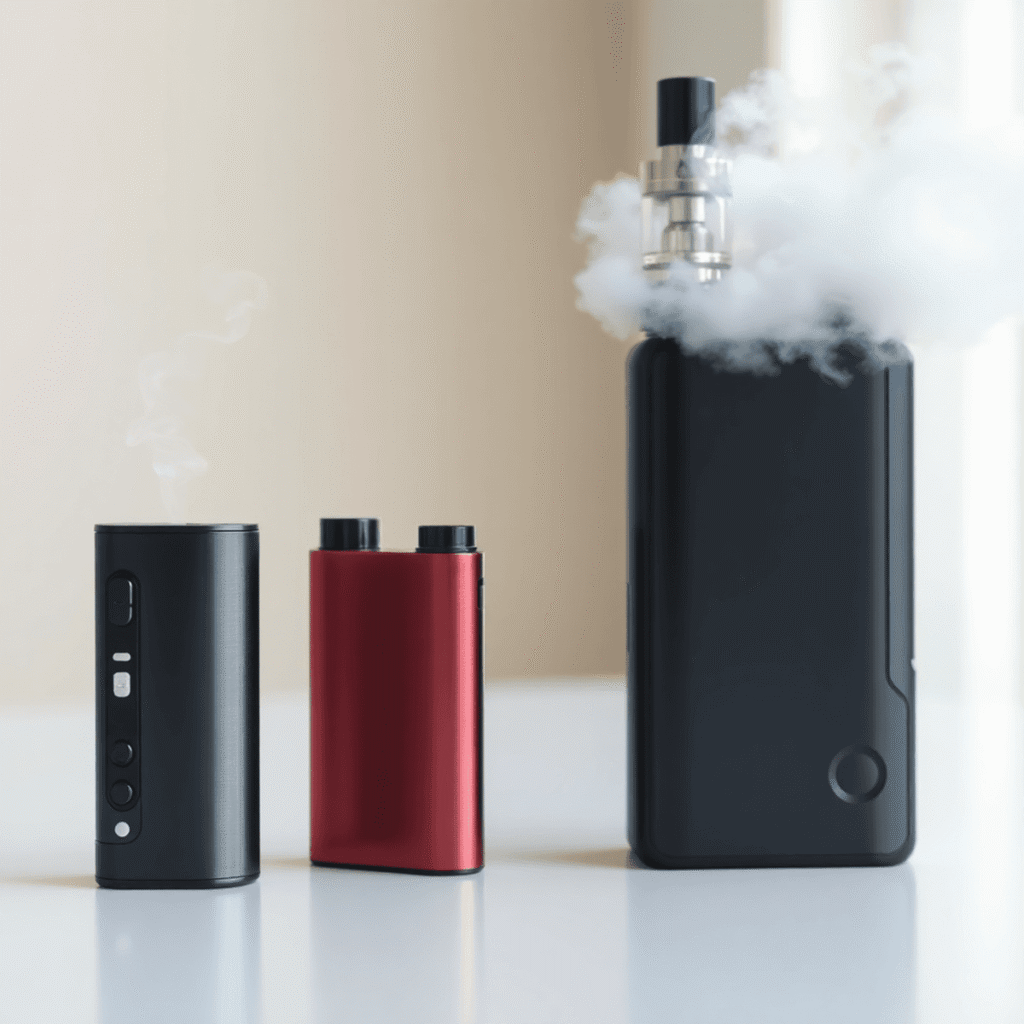
The physical contrast between these device types is striking.
E-liquid Composition and Nicotine Levels for MTL vs DTL Vaping Styles
The e-liquid you choose plays a crucial role in determining your vaping experience, and the composition varies significantly between MTL and DTL styles. Understanding the PG vs VG ratio in e-liquids and appropriate nicotine strengths for vaping styles will help you select the right product for your device and preferences.
Why MTL Vaping Favours Higher PG Ratios
Propylene Glycol (PG) is a thinner liquid that carries flavour exceptionally well and produces that satisfying throat hit many ex-smokers crave. MTL vapers typically use e-liquids with a 50/50 or 60/40 PG/VG ratio for several important reasons:
- Enhanced throat hit – PG delivers a sharper sensation at the back of your throat, closely mimicking the feeling of smoking a traditional cigarette
- Superior flavour delivery – The thinner consistency allows flavour molecules to be more pronounced, giving you a more intense taste experience
- Better wicking – High-resistance MTL coils work more efficiently with thinner liquids, preventing dry hits and extending coil life
- Reduced vapour production – Less visible clouds mean you can vape more discreetly in public settings
When I first switched from smoking to vaping, I found that 50/50 e-liquids gave me exactly what I needed – that familiar sensation without the overwhelming clouds that made me feel self-conscious.
Nicotine Concentrations for MTL Devices
MTL vaping accommodates higher nicotine concentrations, typically ranging from 6mg to 20mg per millilitre. You’ll find two main types of nicotine suitable for MTL:
Freebase Nicotine (6mg-18mg)
- Traditional form of nicotine used in e-liquids
- Provides a strong throat hit at higher concentrations
- Takes slightly longer to satisfy cravings compared to nicotine salts
Nicotine Salts (10mg-20mg)
- Smoother throat hit even at higher strengths
- Faster absorption into your bloodstream
- Ideal for heavy smokers transitioning to vaping
- Works perfectly with pod systems and low-wattage devices
For instance, 20mg Nic Salt 10ml By Nic Nic, which has a balanced 50VG/50PG ratio, is formulated specifically for smokers and dual users seeking quicker absorption. Likewise, 20mg Aroma King Nic Salts also offer a similar smooth satisfaction with high-quality nicotine salt e-liquid.
Nicotine salts have revolutionised MTL vaping because you can use 20mg strength without the harsh throat hit that freebase nicotine would produce at the same level. This makes them particularly effective for satisfying nicotine cravings quickly, which is exactly what you need when you’re trying to quit smoking.
Why DTL Vaping Requires Higher VG Content
Vegetable Glycerin (VG) is a thicker, sweeter liquid that produces dense vapour clouds. DTL vapers typically use e-liquids with a 70/30 or 80/20 VG/PG ratio, and here’s why this composition works best:
- Massive vapour production – VG creates thick, fluffy clouds that are perfect for cloud chasing and sub-ohm vaping
- Smooth inhale – The higher VG content results in a smoother draw, making it easier on your throat and lungs during large inhales
- Compatibility with high wattage devices – Sub-ohm tanks and rebuildable atomisers (RDAs) require thicker liquids like VG to keep up with their power demands
When I transitioned from MTL to DTL vaping, I realised how crucial VG was for my setup. Using e-liquids with an 80/20 VG/PG ratio allowed me to create those massive clouds while still enjoying rich flavours.
Nicotine Levels for DTL Vaping
DTL vapers generally prefer lower nicotine concentrations compared to MTL users since they inhale directly into their lungs. The typical range of nicotine strength suitable for DTL devices is between 3mg to 6mg per millilitre. Here’s why:
- Direct lung inhales can deliver higher amounts of nicotine compared to mouth-to-lung inhales.
- Lower nicotine levels help prevent any potential harshness or discomfort during large puffs.
- It allows vapers who enjoy larger vapour production without overwhelming doses of nicotine.
For example, if you’re using an RDA or sub-ohm tank capable of producing big clouds, opting for a 3mg strength e-liquid will ensure you get your desired satisfaction without any harshness on the inhale.
Understanding these differences in e-liquid composition and nicotine levels between MTL and DTL styles will empower you to make informed choices tailored specifically towards enhancing your vaping experience!
Pros and Cons of Mouth-to-Lung Vaping Style
The benefits of the MTL vaping style make it an attractive option for specific types of vapers, particularly those making the switch from traditional cigarettes. Understanding both the advantages and limitations helps you determine whether this approach aligns with your vaping goals.
Key Benefits of MTL Vaping
Seamless Transition from Smoking
MTL vaping replicates the exact inhalation technique you used when smoking cigarettes. You draw vapour into your mouth first, then inhale it into your lungs – the same two-step process that feels natural and familiar. This similarity reduces the learning curve dramatically, allowing you to adapt to vaping without retraining your muscle memory or breathing patterns.
Enhanced Throat Hit Satisfaction
The tighter draw combined with higher nicotine concentrations delivers a pronounced throat hit that closely mimics the sensation of smoking. Many former smokers find this physical feedback essential for satisfaction, as it provides the tactile confirmation they’ve grown accustomed to over years of cigarette use. The throat hit serves as a sensory marker that helps satisfy nicotine cravings more effectively.
Discreet and Convenient Usage
MTL devices produce significantly less vapour than their DTL counterparts, making them ideal for situations where you need discretion. You can vape in public spaces without drawing excessive attention or creating large clouds that might disturb others. The smaller vapour output means:
- Less visible exhalation
- Minimal lingering vapour in the air
- Reduced odour dispersion
- Greater social acceptability in various settings
Lower E-liquid Consumption
The combination of smaller devices, tighter airflow, and higher nicotine concentrations means you’ll use less e-liquid per session. A single tank can last considerably longer with MTL vaping compared to DTL, translating to better value for money and fewer refills throughout the day.
Portable and User-Friendly Devices
MTL setups typically feature compact designs that fit comfortably in your pocket or bag. Pod systems and smaller pen-style devices require minimal maintenance, making them perfect for vapers who prioritise simplicity over customisation. You won’t need to carry spare batteries, multiple bottles of e-liquid, or complex tools.
Better Battery Efficiency
Operating at lower wattages means MTL devices consume less power. You’ll enjoy longer battery life between charges, which proves particularly valuable when you’re away from home or travelling. Some MTL pod systems can last multiple days on a single charge with moderate use.
Cost-Effective Entry Point
MTL devices generally cost less than advanced DTL setups. You’ll spend less on the initial device purchase, replacement coils, and e-liquid consumption. This makes MTL vaping an economical choice for budget-conscious users or those testing whether vaping suits their needs.
Drawbacks of MTL Vaping Style
Limited Vapour Production
The most significant limitation of MTL vaping is the modest vapour output. If you’re interested in producing large, dense clouds, MTL devices won’t deliver the visual spectacle you’re seeking. Advanced vapers who enjoy cloud production often find MTL vaping underwhelming in this regard.
Restricted Customisation Options
MTL devices offer fewer adjustable parameters compared to DTL setups. You’ll have limited control over:
- Airflow settings (typically fixed or minimally adjustable)
- Wattage ranges (lower power outputs)
- Coil resistance options (primarily high-resistance coils
Pros and Cons of Direct-to-Lung Vaping Style
Advantages of DTL Vaping Style
1. Massive Vapour Production
DTL vaping delivers what many experienced vapers crave: thick, billowing clouds of vapour. You’ll produce significantly more vapour compared to MTL devices, which makes DTL the preferred choice for cloud chasers and those who enjoy the visual spectacle of vaping. The high-VG e-liquids combined with powerful sub-ohm coils create dense plumes that can fill a room.
2. Enhanced Flavour Intensity
The increased vapour production doesn’t just look impressive – it carries more flavour molecules to your taste buds. You’ll experience e-liquid flavours in their full complexity, with subtle notes becoming more pronounced. The larger surface area of low-resistance coils heats more e-liquid simultaneously, releasing a richer, more nuanced flavour profile that MTL devices simply cannot match.
For instance, a high VG e-liquid like the Major Flavour Reloaded 100ml Shortfill works best in a sub-ohm vape tank, providing an optimal experience for DTL vapers.
3. Satisfying Lung Sensation
DTL vaping provides a unique sensation that many vapers find deeply satisfying. The warm vapour filling your lungs creates a fuller, more substantial feeling compared to the mouth-focused experience of MTL. You’ll notice this particularly if you enjoy taking deep, deliberate draws that engage your entire respiratory system.
4. Lower Nicotine Requirements
Because DTL vaping delivers vapour more efficiently, you’ll typically need lower nicotine concentrations to achieve satisfaction. This means you can gradually reduce your nicotine intake more easily if that’s your goal. Many DTL vapers use 3mg or 6mg nicotine strengths, compared to the 12mg-20mg common in MTL vaping.
An example of such an e-liquid is the 10mg Bar Series Gold Edition Nic Salt, which offers a sophisticated experience with lower nicotine levels.
5. Customisation and Control
DTL devices offer extensive customisation options. You can adjust wattage, airflow, coil resistance, and temperature to fine-tune your experience. This level of control lets you experiment and discover your perfect vaping setup, adapting it to different e-liquids or your mood on any given day.
Disadvantages of DTL Vaping Style
1. Steeper Learning Curve
DTL devices require more knowledge and maintenance than their MTL counterparts. You’ll need to understand battery safety, coil building (for rebuildable atomisers), wattage ranges, and proper wicking techniques. The complexity can feel overwhelming when you’re starting out, especially if you’re transitioning directly from smoking without prior vaping experience.
2. Device Management Demands
These powerful devices consume e-liquid at an alarming rate – you might go through 10-15ml per day compared to 2-3ml with MTL vaping. You’ll also drain batteries faster, requiring frequent recharging or carrying spare batteries. The maintenance schedule includes regular coil changes, tank cleaning, and monitoring for potential issues like leaking or dry hits.
To mitigate some of these costs, it’s beneficial to choose e-liquids wisely. For example, the 0mg Imp Jar X Zeus Bolt 50ml Shortfill
Which Vaping Style is Best? Factors to Consider When Choosing Between MTL and DTL Styles
The truth is, there’s no universal “best” vaping style – choosing best vape style depends entirely on your individual needs, preferences, and circumstances. I’ve seen countless vapers struggle because they picked a device based on what looked cool or what their friend recommended, rather than what actually suited their vaping goals.
Your Smoking History and Transition Goals
If you’re coming straight from cigarettes, MTL vaping typically offers the smoothest transition. The familiar draw resistance and throat sensation mirror what you’ve been accustomed to for years. I’ve watched many new vapers fail with DTL setups simply because the experience felt too different, too overwhelming. They ended up back on cigarettes because they couldn’t adapt.
For recent ex-smokers:
- MTL provides the cigarette-like draw you’re craving
- Higher nicotine levels satisfy cravings more effectively
- The hand-to-mouth action feels natural and familiar
- Discreet vapour production won’t draw unwanted attention
If you’ve been vaping for a while and want to explore something new, DTL might offer the change you’re seeking. You’re already comfortable with vaping mechanics and ready for a different experience.
Throat Hit Intensity Preferences
Your desired throat hit plays a massive role in choosing best vape style. Some vapers need that sharp, satisfying hit at the back of their throat – it’s what makes vaping feel “real” to them. Others find intense throat hits uncomfortable and prefer smoother sensations.
MTL delivers when you want:
- A pronounced throat hit similar to smoking
- Satisfaction from higher nicotine concentrations
- That “kick” feeling with each inhale
DTL works better if you prefer:
- Smoother, less aggressive sensations
- Vapour warmth over throat sharpness
- Adjustable intensity through e-liquid choices
Vapour Production Expectations
Be honest with yourself about vapour volume. Do you want massive clouds that fill a room, or would you rather keep things subtle? Your answer significantly impacts which style suits you.
I’ve met vapers who thought they wanted huge clouds until they realised how impractical it was for their daily life. Conversely, I’ve seen MTL users eventually crave more vapour production and switch to RDL or DTL setups.
Consider your vapour preferences:
- Minimal vapour: MTL is your friend – discreet, controlled, practical
- Moderate vapour: RDL offers a balanced middle ground
- Maximum vapour: DTL produces the dense clouds you’re after
Device Complexity Tolerance
Beginner vapers advice always includes assessing your comfort level with technology. MTL devices, particularly pod systems, offer simplicity. You fill the pod, charge the battery, and vape. No wattage adjustments, no coil building, no complicated settings.
DTL devices often require more involvement:
- Adjusting wattage to match your coil resistance
- Managing airflow settings for optimal performance
- Understanding battery safety with high-power mods
- Regular maintenance and coil changes
- Monitoring e-liquid consumption (DTL burns through juice faster)
If you’re tech-savvy and enjoy customisation, DTL’s complexity might appeal to you. If you want simplicity and reliability, MTL devices make more sense.
Nicotine Requirements
Your nicotine needs directly influence personal preference in vape style. Heavy smokers transitioning to vaping typically need higher nicotine levels such as those found in 20mg nic salt e-liquids.
Understanding these factors can help guide your decision between MTL and DTL styles. Remember that everyone’s journey is unique – what works for one person may not work for another.
Conclusion
Your vaping journey is uniquely yours, and understanding the Mouth-to-Lung vs Direct-to-Lung vaping styles empowers you to make informed decisions that align with your needs and preferences.
The choice between MTL and DTL isn’t about finding the objectively “best” option – it’s about discovering what works best for you. If you’re transitioning from traditional cigarettes, MTL vaping offers that familiar draw and satisfying throat hit you’re accustomed to. You’ll appreciate the discreet vapour production and the straightforward device operation that doesn’t require extensive technical knowledge.
On the other hand, if you’re drawn to impressive vapour clouds and intense flavour experiences, DTL vaping delivers exactly that. You’ll need to invest time in understanding your device settings and e-liquid compositions, but the payoff is a customisable experience that can be tailored to your exact specifications.
Don’t overlook RDL vaping either. This hybrid approach gives you flexibility, allowing you to enjoy substantial vapour production without the overwhelming intensity of full DTL vaping. You might find this middle ground perfectly suits your lifestyle and preferences.
Consider these priorities when making your selection:
- Your current smoking status and nicotine requirements
- The level of discretion you need in your daily routine
- Your comfort level with device maintenance and settings
- The throat hit intensity you find satisfying
- Your budget for both initial setup and ongoing e-liquid costs
- The time you’re willing to invest in learning device management
Remember, you’re not locked into one style forever. Many vapers experiment with both MTL and DTL setups, using different devices for different situations. You might prefer MTL during work hours for discretion, then switch to DTL at home for a more immersive experience.
The beauty of vaping lies in its versatility. Whether you choose the simplicity of MTL, the intensity of DTL, or the balanced approach of RDL, you’re taking control of your vaping experience. Take your time exploring different options, and don’t hesitate to adjust your setup as your preferences evolve.
Your perfect vaping style is waiting – you just need to identify what matters most to you and select the approach that delivers on those priorities.
FAQs (Frequently Asked Questions)
What is the difference between Mouth-to-Lung (MTL) and Direct-to-Lung (DTL) vaping?
Mouth-to-Lung (MTL) vaping mimics traditional smoking by drawing vapor into the mouth first before inhaling into the lungs, using devices with smaller tanks, high-resistance coils, and higher nicotine e-liquids. Direct-to-Lung (DTL) vaping involves inhaling vapor directly into the lungs with larger mods, low-resistance coils, and e-liquids high in vegetable glycerin for bigger clouds and a smoother hit.
Which vaping style is better for someone transitioning from smoking?
Mouth-to-Lung (MTL) vaping is generally better for smokers transitioning to vaping because it closely replicates the draw of traditional cigarettes, offers a stronger throat hit with higher nicotine levels often using nicotine salts, and produces less vapour, making it more discreet.
What are the typical device characteristics for MTL and DTL vaping?
MTL devices usually feature smaller tanks, high-resistance coils, and lower wattage batteries designed for a tighter draw and flavour concentration. In contrast, DTL devices are larger mods with low resistance coils, advanced airflow controls, and higher power output to produce large dense vapour clouds.
How do e-liquid compositions differ between MTL and DTL vaping styles?
MTL vaping favours e-liquids with higher propylene glycol (PG) ratios and higher nicotine concentrations including nicotine salts to provide a stronger throat hit and satisfaction similar to smoking. DTL vaping prefers e-liquids with higher vegetable glycerin (VG) content for smoother vapour production and typically uses lower nicotine levels to avoid harshness.
What are the pros and cons of Mouth-to-Lung vaping?
Pros of MTL vaping include an easier transition from smoking due to familiar inhalation style, discretion because of less vapour production, and a stronger throat hit preferred by some users. Cons include less intense vapour clouds which may not satisfy advanced vapers seeking large clouds.
Can you explain Restricted Direct Lung (RDL) vaping and its advantages?
Restricted Direct Lung (RDL) vaping is a hybrid style that offers a draw tighter than DTL but more open than MTL. It balances flavour intensity with vapour production effectively, appealing to vapers who want a middle ground between the two main styles.